
How U.S. Bank Stadium’s Hail Damage Relates to Your Bloomington Roof
When hail damaged the U.S. Bank Stadium roof in 2023, it forced a conversation most homeowners had been putting off. If a billion-dollar venue built with cutting-edge roofing materials can get punched through by a Minnesota hailstorm, what chance does a twenty-year-old shingled roof on a Bloomington cul-de-sac have? The answer is not reassuring. Minnesota hail damage is not always dramatic. It does not always send water dripping through your ceiling the same night. But it does weaken your roof in ways that compound over months and seasons, eventually leading to costly repairs that could have been prevented. This article walks through what actually happened at the stadium, why it matters to you, and exactly what Bloomington homeowners should do after the next storm rolls through.
Key Takeaways
- If the engineered ETFE roof at U.S. Bank Stadium sustained punctures and dents from a single hailstorm, standard asphalt shingles on Bloomington homes are far more vulnerable to the same severe weather.
- Minnesota hail damage does not always cause an immediate roof leak, but it can quietly shorten your roof’s life by cracking shingle mats, stripping protective granules, and creating soft spots that worsen with freeze-thaw cycles and sun exposure.
- Shingles, gutters, siding, windows, and exterior components are all common hail damage targets across Bloomington neighborhoods.
- A professional inspection after a storm is worth scheduling even when everything looks fine from the yard, because hidden bruising and hairline fractures are often invisible from the ground.
What Happened to the U.S. Bank Stadium Roof in the 2023 Hailstorm?

On August 11, 2023, a major hailstorm swept through the Minneapolis-Saint Paul metro area. The storm struck U.S. Bank Stadium directly, damaging the translucent ETFE (ethylene-tetrafluoroethylene) panels that make up roughly 60 percent of the stadium’s slanted roof. ETFE is a high-performance polymer membrane engineered for light transmission and weather resistance, chosen specifically for its durability.
The hail punched holes, left dents, and compromised the outer layer’s long-term performance. While engineering assessments confirmed the building’s structural integrity was not compromised and public safety was never at risk, temporary patches could not serve as a permanent fix. As detailed by MPR News, the Minnesota Sports Facilities Authority issued a formal Request for Proposals to evaluate long-term repairs or replacement for the damaged ETFE section, with insurance expected to cover the costs.
The remaining 40 percent of the roof—covered in thermoplastic polyolefin (TPO) over a metal deck—was not damaged in this particular storm. However, if a state-of-the-art, $1-billion facility designed by structural engineers sustains major damage from a single hailstorm, it serves as a stark reminder of what severe weather can do to residential roofs across Bloomington.
This is a state-of-the-art structure. Its roof was designed by engineers with severe weather events in mind. And a single hailstorm in Minnesota still caused enough damage to require full membrane replacement on a majority of the roof surface. That reality should make every homeowner in Bloomington pause and consider the condition of their own roof after the next round of thunderstorms.
Minnesota’s Long History With Destructive Hailstorms
Hail is not a rare occurrence in this part of the country. Minnesota experienced 87 hailstorms from 2012 to 2021, a pace that keeps the state consistently ranked among the most hail-prone in the nation. These are not minor weather footnotes. They carry real consequences for property across the metro and beyond.
The worst hailstorm in Minnesota occurred in Goodhue in 2021. During the June 17, 2021 storm, hailstones up to 3 inches fell, roughly the size of a hockey puck, battering homes, vehicles, and landscaping in the area. That storm alone caused widespread destruction in south central Minnesota and reinforced the reality that severe storms in this region can produce stones large enough to fracture nearly any residential roofing system.
The financial toll is staggering. Minnesota had $799 million in hail damage claims in 2022, reflecting both the frequency of storms and the sheer volume of exposed property. Nationally, annual insured losses from hail now exceed $10 billion, a dramatic increase from roughly $850 million in 2009. The trend line is clear: hail claims are rising, not declining.
Within a 10-mile radius of Bloomington, there have been over 200 reported hail events since 2004, with the largest recorded stone measuring 3 inches in diameter. The most active months tend to be May, July, and August, and August often delivers both the highest frequency and the largest hail during the peak of severe weather season.
This is not a freak event. It is a seasonal pattern that homeowners in the Twin Cities should actively prepare for each year.
Why Bloomington Homes Are Squarely in the Hail Impact Zone
Bloomington sits within a corridor that channels severe weather through the metro area every spring and summer. Minnesota’s hail season starts in late May for southern regions and extends well into August, overlapping with the warmest and most unstable atmospheric conditions of the year.
Dense residential neighborhoods across Bloomington mean thousands of roofs are simultaneously exposed during any single storm. Most of these houses are covered with asphalt shingles, and many are fifteen to twenty-five years old. The age and condition of roofing materials directly affect how much damage a roof absorbs.
Several factors influence how hail impacts a specific home:
- Roof pitch and orientation relative to the storm’s direction
- Whether trees provide partial shelter or channel wind-driven hail
- The age and condition of existing shingles, flashing, and sealants
- The presence of skylights, vents, or other penetrations that create weak points
Consider a typical Bloomington block. One homeowner finds visible dents across their gutters and metal vent caps after a storm. The neighbor across the street sees nothing unusual from the driveway but later discovers scattered granule loss across their south-facing slope during a professional inspection. A third home, tucked behind mature trees, shows minimal exterior signs but has cracked pipe boots and lifted ridge cap shingles.
All three houses were hit by the same hailstorm. All three need attention. The variation in visible damage does not mean the variation in actual damage is the same.
How Commercial Roofing Differs From Residential Roofing in a Hailstorm
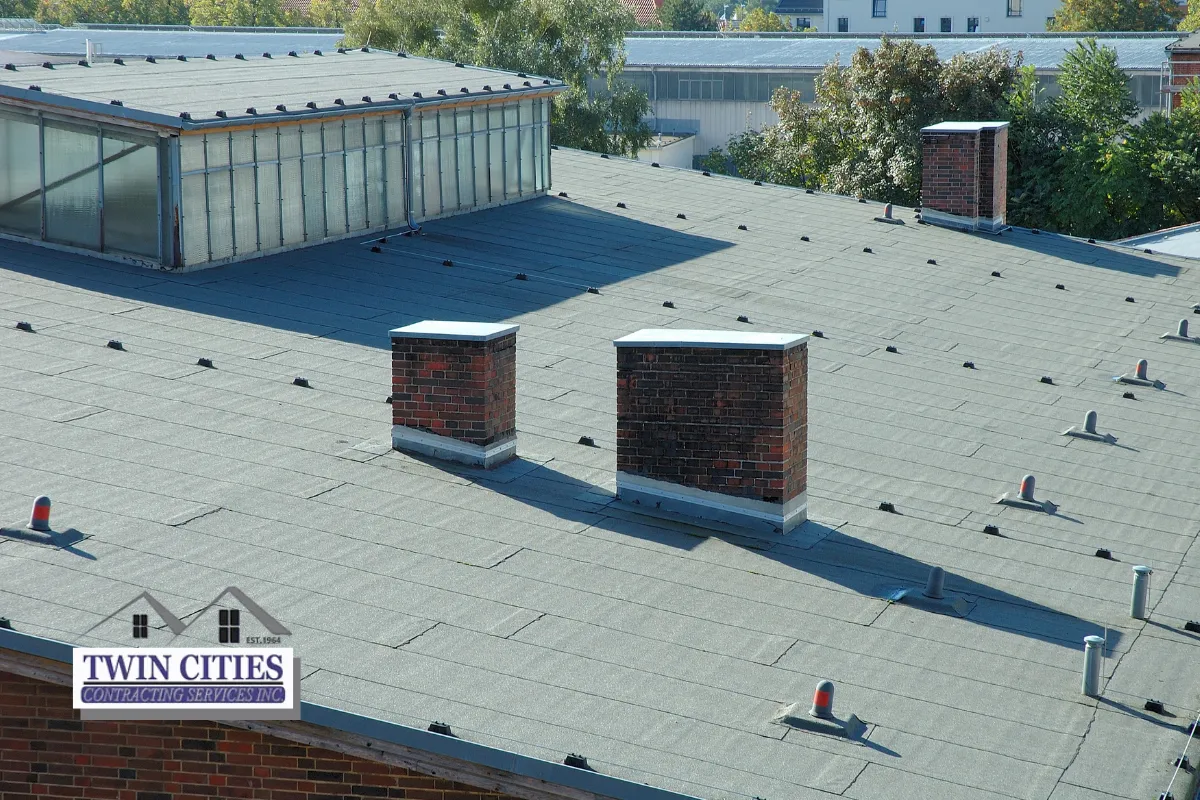
The U.S. Bank Stadium roof is a commercial installation on a scale that dwarfs any residential project. Its ETFE panels are tensile membranes stretched across a steel cable structure, designed primarily for light transmission and snow load management. The remaining section uses TPO, a common commercial membrane. Both are flat or low-slope systems.
Residential roofs in Bloomington are fundamentally different. They are steep-slope systems, predominantly covered in asphalt shingles, with metal flashing around penetrations, valleys, and edges. Here is how the two compare under hail assault:
| Feature | Commercial (Stadium) | Residential (Bloomington Home) |
| Primary material | ETFE membrane, TPO | Asphalt shingles |
| Roof slope | Flat to low-slope | Steep-slope (pitched) |
| Impact absorption | Membrane stretches, may puncture | Shingles bruise, crack, lose granules |
| Inspection frequency | Regular, professional maintenance | Often only after visible problems |
| Redundancy | Multiple layers, engineered backup | Typically single shingle layer over underlayment |
A flat or low-slope roof spreads hail impact differently than a pitched residential roof. Hailstones striking at a steep angle may glance off one slope while hammering another directly. On a flat membrane, hail hits more uniformly.
But the physics of hail remain the same regardless of roof type. Kinetic energy from a falling stone transfers into the surface it strikes. Size, velocity, and angle determine whether that energy causes a dent, a bruise, or a full breach. Homeowners should never assume that only large commercial properties need inspection after storms. Houses need the same attention.
How a Bloomington Roof Actually Absorbs Hail Impact

Hailstones form high in the atmosphere when updrafts carry raindrops into freezing altitudes. The stones grow as they cycle through layers of supercooled water, adding concentric layers of ice until gravity pulls them down. By the time they reach ground level, their velocity can be significant, especially when hailstones vary in size from pea-sized pellets to stones exceeding two inches in diameter.
The moment of impact is where the damage begins. A hailstone striking a shingle at speed transfers its kinetic energy into the roofing surface. That energy can:
- Compress and fracture the shingle mat beneath the granule surface
- Displace or crush protective granules, exposing raw asphalt underneath
- Dent or deform metal components like flashing, vent collars, and chimney caps
- Crack or puncture softer materials around roof penetrations
High winds during a storm amplify the effect by driving hail at an angle rather than straight down. This means windward-facing slopes often take more punishment than sheltered sides. Heavy rain accompanying the hail can also wash loosened granules into gutters and downspouts, creating visible evidence of the storm’s severity at ground level.
The extent of damage depends on a combination of hailstone size, wind speed, roof material, roof age, and angle of impact. No two storms hit the same way, and no two roofs respond identically.
What Hail Does to Asphalt Shingles on Bloomington Homes
Asphalt shingles dominate the residential roofing landscape in Bloomington. Understanding how hail interacts with this material is essential for any homeowner who wants to protect their property.
Hail over 1 inch can commonly damage residential roofing systems. At this size, the impact energy is sufficient to cause functional harm, not just cosmetic scuffing. Three-tab shingles, the thinnest and most basic style, tend to show damage at smaller hail sizes. Laminated or architectural shingles are thicker and more impact resistant, but they are not immune.
Here is what hail does to asphalt shingles:
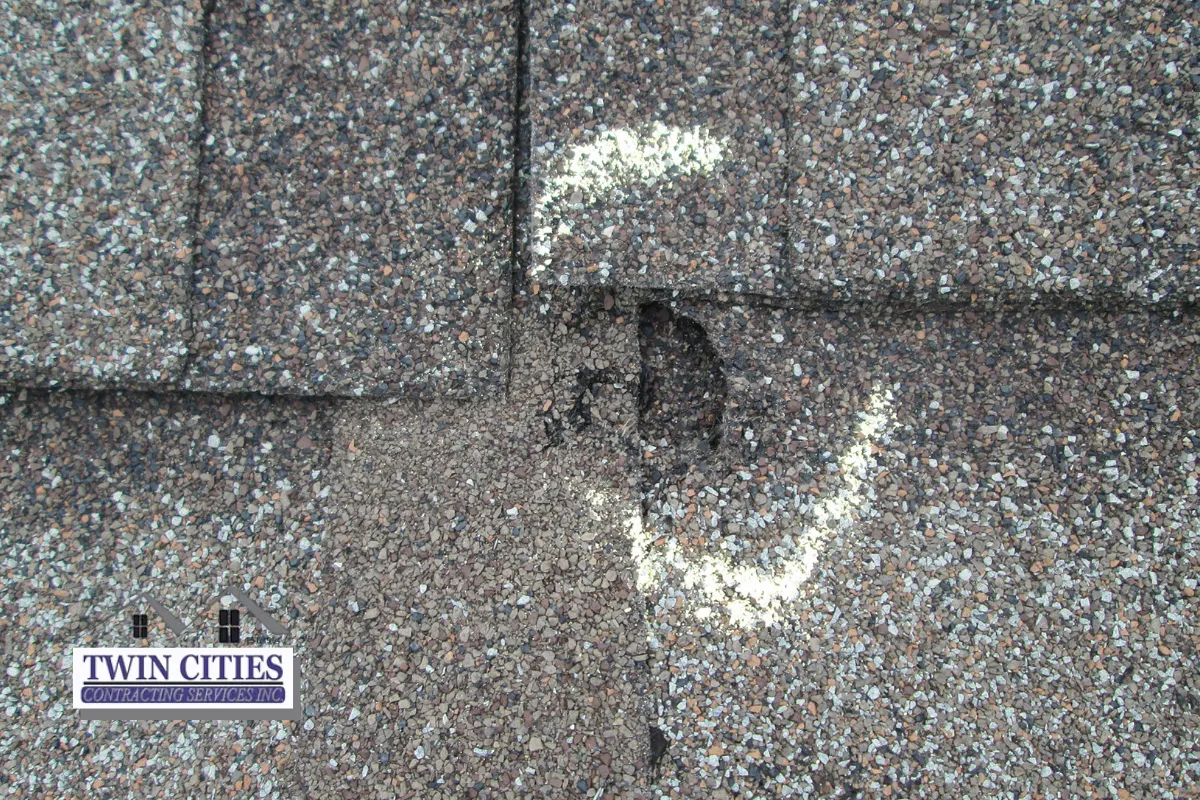
- Circular bruises appear where the stone struck, sometimes visible as dark spots where granules are crushed into the mat
- Granule loss exposes the underlying asphalt layer, which then degrades faster under sunlight and temperature swings
- Large hailstones can fracture the fiberglass mat beneath shingles, creating a structural weakness that may not be apparent on the surface
- Hail can create soft spots in roofing materials leading to leaks, detectable only by pressing on the shingle during a hands-on inspection
- Surface cracks may develop at or near the point of impact, sometimes radiating outward as the shingle flexes
Not every mark on a roof is legitimate hail damage. Blistering from manufacturing defects, foot traffic scuffs, and normal weathering can all leave marks that resemble hail impacts. The distinction between cosmetic wear and functional, performance-reducing damage matters, and it takes a trained eye to make that call confidently.
Homeowners who try to self-diagnose from the ground are working with limited information. This knowledge is most useful when it helps you have a more informed conversation with a qualified roofing professional.
Why a Roof Doesn’t Have to Leak Immediately to Be Seriously Damaged

This is one of the most misunderstood aspects of hail damage to roofs. Many homeowners check their ceilings after a storm, see no stains, and assume everything is fine. But the absence of a drip does not mean the absence of damage.
Bruised shingles often develop fractures that start on the underside and work upward. These cracks may not penetrate the full thickness of the shingle right away. Instead, they weaken the mat’s structure, and compromised roofing materials can lead to water intrusion over time as the shingle flexes through seasonal temperature changes.
Granule loss is another slow-motion problem. When protective granules are knocked off, the exposed asphalt layer absorbs more UV radiation and heat. This accelerates cracking and brittleness. Granule loss on shingles increases the risk of roof failure because the asphalt dries out faster than it would under an intact granule layer.
Freeze-thaw cycles are particularly punishing. Water seeps into hairline cracks during rain or snowmelt. When temperatures drop, that water expands as ice, widening the crack. Repeat this over a few Minnesota winters and what started as a minor bruise becomes a path for water to reach the underlayment and decking below.
Delayed leaks may appear months or even a full year after the original storm. By the time a homeowner notices a ceiling stain, the damage has often spread beyond the shingles to include saturated sheathing, wet insulation, and possibly the early stages of rot.
Timely inspection and repair interrupt this cycle before small issues compound into serious water damage.
Visible Signs of Hail Damage a Bloomington Homeowner Can Spot
You do not need to climb onto your roof to gather useful information after a hailstorm. A careful ground-level walkthrough can reveal a lot about what your roof may have experienced.
Start with these exterior indicators:
- Dents in aluminum gutters, especially along the top lip and front face. Gutters can bend and dent during hailstorms, disrupting drainage and signaling that roof-level impacts were significant.
- Dings on downspouts and metal trim pieces around the roofline
- Impact marks on vinyl or metal siding, particularly on walls facing the direction the storm came from
- Splatter marks or fresh chips on painted wood trim, fascia boards, and doors
- Dents or cracks on outdoor AC unit housings
- Pockmarks on wooden deck railings, fence posts, and outdoor furniture
If you can safely view your roof from a second-story window or with binoculars, look for:
- Dark spots or circular marks on lighter-colored shingles
- Patches where granule color appears inconsistent, suggesting recent displacement
- Cracked or missing shingle tabs, especially along ridges and edges
Check the ground around your downspout outlets. A heavy accumulation of granules in the splash area after a storm is a strong sign that shingles lost surface material during the hail event.
Do not climb onto the roof without proper training and equipment. A ground-level assessment gives you enough information to decide whether a professional inspection is the logical next step.
Subtle or Hidden Hail Damage You Will Not See From the Yard
Some of the most consequential damage from a hailstorm is invisible from the driveway. Hail damage may not be immediately visible during initial inspections, and that is precisely why professional evaluations exist.
Up close on the roof surface, a trained inspector may find:
- Lifted shingle edges where adhesive strips were broken by impact
- Fine hairline cracks radiating from impact points that are not visible from even ten feet away
- Soft spots that compress under hand or foot pressure, indicating fractured mat beneath the surface
- Damaged chimney caps, skylight frames, and pipe boots that are completely out of sight from ground level
One subtle but telling sign is the displacement of granules into gutters and downspout outlets. After a storm, a homeowner might not notice anything wrong with the shingles themselves but can find a thick layer of colored grit clogging gutter screens. That grit came from the roof surface, and its absence up top means reduced protection against sunlight and moisture.
Repeated minor hail events over several seasons can weaken shingles incrementally. Each storm strips a few more granules, adds another hairline fracture, softens another small area. Individually, none of these events looks alarming. Cumulatively, they can cut years off a roof’s service life.
This is the core reason why a professional roof inspection is fundamentally different from a quick homeowner glance. The tools, access, and experience a roofer brings to the evaluation catch problems that would otherwise go unnoticed until a leak develops.
How Hail Interacts With Other Types of Residential Roofing Materials
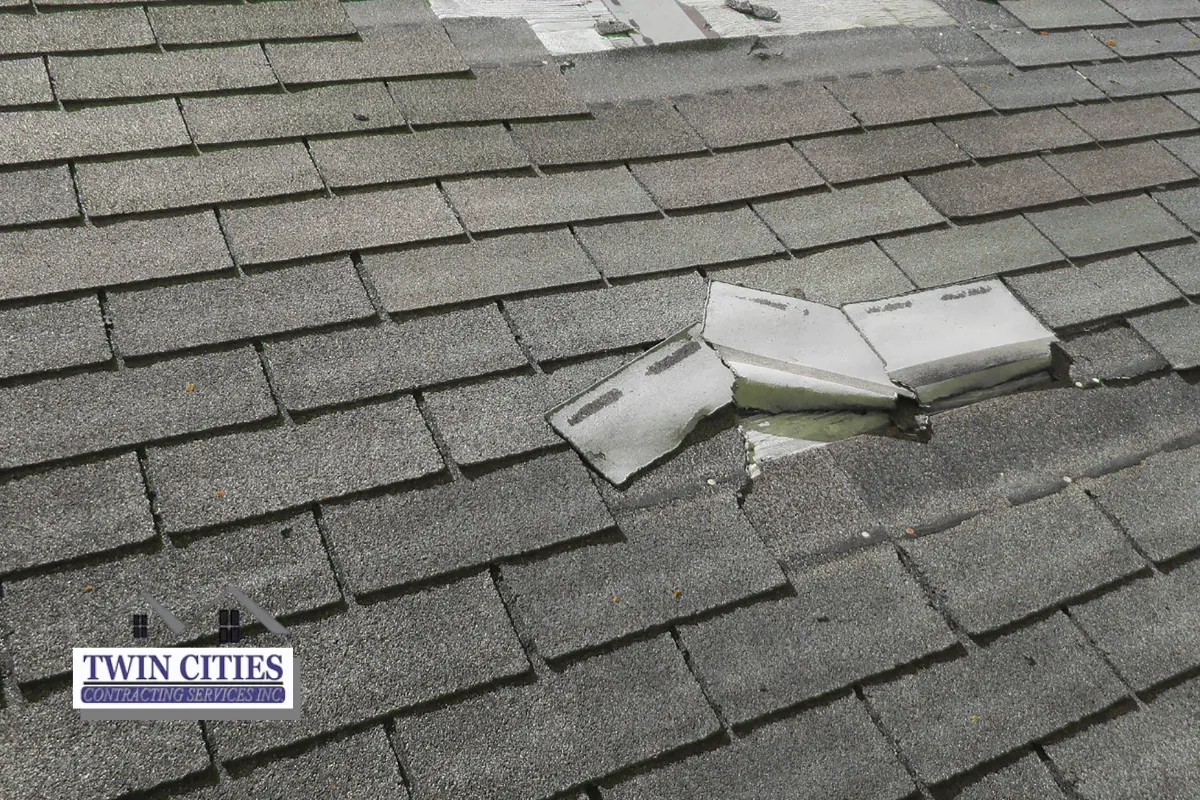
While asphalt dominates Bloomington’s housing stock, some homes feature alternative roofing materials that respond to hail differently.
- Wood shakes and shingles tend to split or show fresh, sharp breaks where hailstones struck. The splits may be clean and easy to see, but the underlying structural weakening can allow water to penetrate.
- Metal roofing panels or standing seam systems typically dent rather than crack. While many dents are cosmetic and do not compromise the panel’s ability to shed water, heavy denting near seams or fasteners can create leak paths over time.
- Composite or synthetic shingles engineered for impact resistance generally perform better than standard asphalt under moderate hail. However, even shingles rated under the UL 2218 impact resistance classification have limits. Large, hard stones or unusual impact angles can still cause functional damage.
Many Bloomington homes have mixed materials across their roof system. A home might have asphalt shingle fields with metal valleys, aluminum flashing around a brick chimney, and rubber pipe boots at plumbing penetrations. All of these components need to be checked after severe weather, because a failure at any one of them can become a leak source.
The point here is awareness, not material promotion. Knowing what is on your roof helps you understand what kind of damage to look for and what questions to ask a contractor.
Why One House Has Hail Damage and the Neighbor’s Roof Looks Fine
Hail does not fall in uniform sheets. It falls in streaks, bands, and pockets driven by wind currents within the storm cell. One side of a street can receive direct hits while the opposite side catches only glancing blows.
Several variables explain why damage varies from house to house:
- Roof pitch affects how directly hail strikes the surface. A steep slope facing into the wind takes full-force impacts, while a low pitch on the lee side may deflect stones.
- Orientation to the storm determines which slopes are exposed. Homes facing different directions receive different levels of punishment.
- Surrounding trees and structures can act as partial shields, deflecting or absorbing hail before it reaches the roof. Conversely, gaps in tree canopy can funnel hail toward specific areas.
- Roof age and material condition play a major role. A ten-year-old architectural shingle might absorb the same impact that cracks a twenty-five-year-old three-tab shingle.
Hail can damage roofs even if neighbors are unaffected. This is critical for homeowners to understand. Just because the house next door shows no visible problems does not mean your roof escaped unscathed. The decision to inspect should be based on storm reports and conditions at your specific home, not on what the neighbor’s place looks like.
How High Winds Compound Hail Damage During a Storm
High winds during a thunderstorm change the geometry of hail impact. Instead of falling straight down, hailstones driven by wind strike the roof at an angle, concentrating force on windward-facing slopes and increasing the effective velocity at the point of contact.
Wind damage also affects shingles independently of hail. Strong gusts can lift shingle tabs, crease edges, and break the adhesive seal strips that hold shingles flat against each other. Once a tab is lifted, the nail underneath is exposed, and the shingle becomes far more susceptible to both further wind damage and water intrusion.
When wind damage and hail damage occur in the same storm, the combined effect is often worse than either alone. A lifted tab that also takes a hail strike may crack completely. A creased edge with granule loss becomes a fast track for moisture to reach the underlayment.
Bloomington storms frequently include both wind and hail. Any post-storm inspection should account for both types of damage, checking not only for impact marks but also for lifted, curled, or creased shingles across the entire roof surface.
What Bloomington Homeowners Should Inspect Right After a Hailstorm
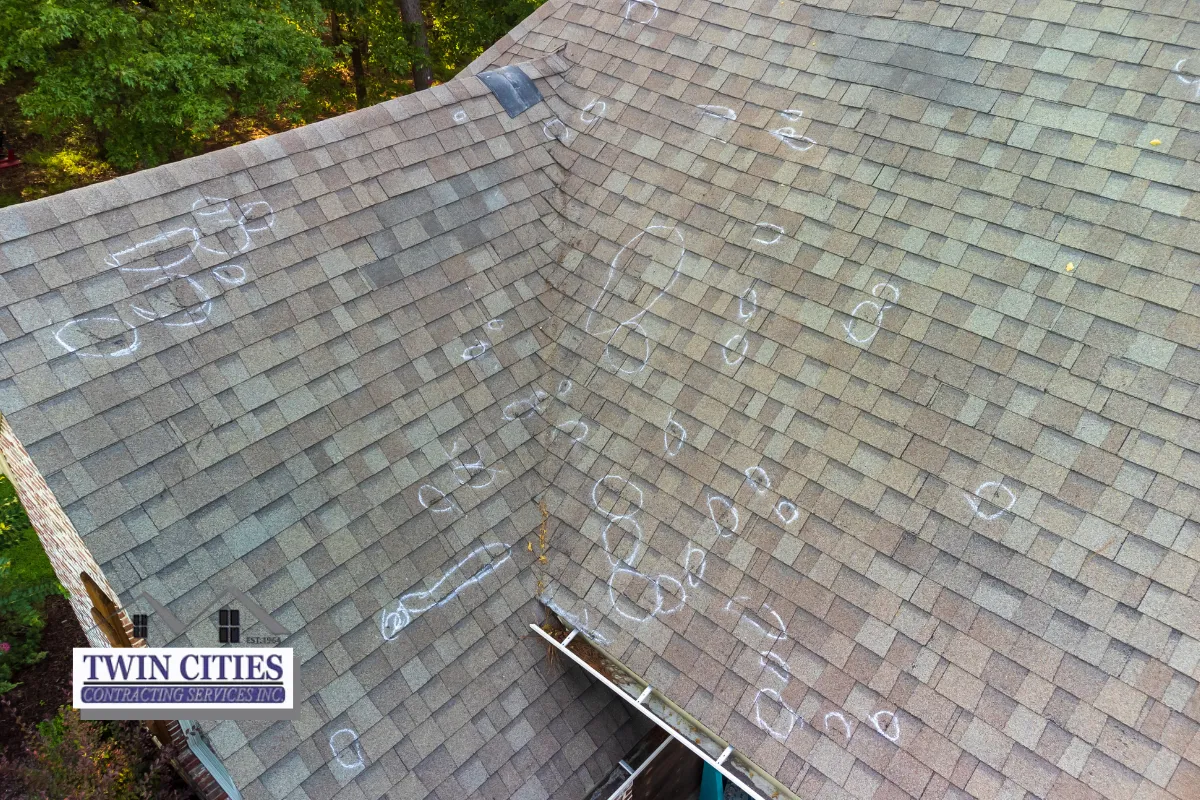
Within 24 to 48 hours after a hailstorm passes and conditions are safe, walk the perimeter of your home and look at the following areas:
- Roofline and gutters: scan for visible dents, bent sections, or sagging gutter runs
- Downspouts: check for dents and look at the base for granule accumulation
- Siding: inspect all sides of the house, especially the side that faced the storm, for chips, cracks, or fresh marks
- Windows: look for cracked glass, dented frames, and displaced screen material
- Garage doors: check metal or wood panel surfaces for new dents or dings
- Deck and patio: look at railings, posts, and furniture for impact evidence
- Outdoor AC units: examine the housing and exposed fins for dents or bent components
- Landscaping: note broken branches, stripped leaves, and debris patterns that indicate storm intensity
Take clear photos of anything that looks freshly damaged. Note the date and time of the storm, and check local weather reports for hail size estimates in your area.
A professional roofer should perform a full inspection before any repairs are attempted. Ground-level observations give you a starting point, but roof-level evaluation is where the real assessment happens.
How to Safely Document Potential Hail and Storm Damage
Good documentation starts with your smartphone camera. Here are practical tips:
- Photograph dents and dings from multiple angles, including straight-on and at a slight angle to show depth
- Place a coin, pen, or ruler next to damage marks for scale reference
- Capture wide shots of affected areas as well as close-ups of individual impact marks
- Photograph gutters, siding, and ground-level debris in addition to any roof areas visible from windows
Keep a simple storm log with the following details:
- Date and approximate time the storm hit
- Estimated hail size based on local weather reports or what you observed
- Wind direction and approximate intensity
- Notes about noise level, duration, and any visible hail accumulation on the ground
Thorough documentation helps when discussing options with a contractor or filing a formal insurance claim. In Minnesota, standard homeowner policies typically require claims for wind and hail damage to be filed within one year of the date of loss. Clear, dated photographs paired with storm records strengthen your submission and ensure you meet carrier deadlines. Keep in mind that while most policies cover hail, your out-of-pocket costs will depend on whether your policy uses a flat-dollar or percentage-based wind/hail deductible, as well as whether your roof is covered for Replacement Cost Value (RCV) or Actual Cash Value (ACV).
Do not tamper with roof components or climb ladders if you are not comfortable or experienced. Save all receipts and notes from any emergency tarping or temporary repairs, as these may be relevant later.
Next Steps After You Suspect Hail Damage to Your Bloomington Roof
Once you have gathered your ground-level observations and documented what you found, follow a clear sequence:
- Stay safe. Do not rush onto the roof or attempt repairs without proper equipment.
- Contact a qualified local roofing professional to schedule an inspection. Proactive inspection is crucial after a hailstorm to prevent water damage from developing over the following weeks and months.
- Be present during the inspection if possible, and ask the roofer to explain what they find and what they recommend.
- Get a detailed, written assessment that clearly distinguishes genuine storm damage from normal age-related wear, blistering, or manufacturing anomalies. Under Minnesota Statute § 325E.66, it is illegal for contractors to offer to pay, absorb, or rebate your insurance deductible, so work only with licensed local roofers who provide transparent, itemized estimates without high-pressure sales tactics.
- Discuss repair options and timelines, prioritizing any areas where the damaged roof is most likely to allow water intrusion during the next heavy rain or snowmelt.
A reputable roofer will differentiate between genuine storm damage and pre-existing conditions. They will not pressure you into unnecessary work, and they will explain the difference between urgent repairs and items that can be monitored over time.
Do not ignore minor issues. What looks like a small bruise or a few missing granules today can become a ceiling stain and drywall repair bill next winter. Early action gives you more options and typically costs far less.
Common Myths Bloomington Homeowners Believe About Hail Damage
Several misconceptions circulate among homeowners after every hail season. Here are the most common ones and why they can be costly.
Myth: If my roof is not leaking, it is fine.
A roof can sustain significant hail damage without producing an immediate leak. As discussed earlier, bruised shingles, fractured mats, and granule loss all degrade the roof’s performance over time. By the time a leak appears, the damage is typically far more extensive and expensive to address than it would have been at the time of the storm.
Myth: Only large hailstones cause real damage.
Hail as small as one inch in diameter can harm asphalt shingles, especially those already aged or weathered. Older shingles with reduced flexibility and thinning granule layers are particularly vulnerable. Multiple rounds of smaller hail across several seasons create cumulative wear that shortens the roof’s life.
Myth: My roof is only a few years old, so it cannot be damaged.
New shingles are more resilient than old ones, but they are not invincible. Large or wind-driven hail can bruise or fracture fresh shingles. Hailstorms can result in structural but less common damages in residential properties, meaning even relatively new roofs can suffer functional harm from a severe enough event.
Myth: Every mark on my roof after a storm is hail damage.
Not necessarily. Foot traffic, blistering from manufacturing defects, and normal weathering can all produce marks that look similar to hail impacts. This is exactly why expert evaluation matters. A professional can determine what is genuine storm damage and what is something else entirely.
Knowledge and proactive checks remain a homeowner’s best defense. The stadium roof story illustrates that clearly: even the best-engineered systems have vulnerabilities.
The Cost of Waiting: How Delayed Hail Repairs Affect Your Home
Procrastination after a hailstorm is one of the most expensive decisions a homeowner can make. Here is how the damage timeline typically unfolds in a Bloomington scenario.
A summer hailstorm leaves scattered bruises and granule loss across a south-facing roof slope. The homeowner checks the ceiling, sees nothing, and moves on. Over the fall, exposed asphalt dries out and begins to crack under UV exposure. Winter arrives, and moisture from snow and ice melt seeps into those cracks. Freeze-thaw cycles widen them. By the following spring, water has reached the sheathing. The plywood softens. Moisture intrusion can cause mold and wood rot if roofing materials are compromised, and by the time a stain appears on the bedroom ceiling, the repair now includes shingle replacement, sheathing repair, insulation, drywall, and possibly mold remediation.
Hail damage can lead to leaks and costly repairs that far exceed what an early shingle repair would have cost. The financial gap between a prompt fix and a delayed one can be thousands of dollars, not to mention the disruption to daily life during interior work.
Beyond the direct repair costs, a damaged roof reduces energy efficiency. Wet insulation loses its thermal resistance, which means higher heating bills during Minnesota winters. It also affects the long-term value of the property if damage goes unaddressed and compounds.
The simple takeaway: catching small problems early keeps them small.
Working With a Roofing Professional in Bloomington After a Hailstorm
A thorough hail inspection should cover more than just the shingle surface. Here is what a complete evaluation includes:
- Full roof walkthrough covering every slope, ridge, valley, and penetration
- Examination of attic space for signs of moisture, daylight penetration, or sagging decking
- Inspection of gutters, downspouts, and drip edges for dents and displacement
- Assessment of metal flashing around chimneys, skylights, walls, and vents
- Review of all exterior components including siding, trim, and windows
Professional inspections can identify hidden hail damage that ground-level walkthroughs miss entirely. A qualified roofer knows how to differentiate hail damage from age-related wear, blistering, and manufacturing anomalies. They can also identify damage relevant to insurance claims, providing documentation that supports any filing.
When working with a roofer, ask questions. Request photos of what they found. Ask them to explain the difference between what needs immediate repair and what can be monitored. A trustworthy contractor will provide a balanced assessment that includes what is damaged and what remains in good condition.
Choose a local, established company that understands Bloomington’s building codes, weather patterns, and housing stock. A roofer familiar with the community will provide more relevant guidance than a traveling crew that arrived after a storm.
How Bloomington Roofers Evaluate Hail Damage to Shingles
The evaluation process is methodical. A professional roofer will typically:
- Walk each roof slope, starting with the side most exposed to the storm’s direction
- Look for patterns of impact marks that are consistent in shape and distribution, matching known hail damage characteristics
- Gently press suspected bruises to feel for soft spots or mat fractures beneath the granule surface
- Inspect ridge caps, which are highly exposed to hail from multiple angles
- Check valleys and low points where water flow concentrates, because even minor damage here can cause disproportionate problems
- Examine areas around penetrations such as plumbing vents, exhaust fans, and skylights, where hail often damages boots and seals
After the evaluation, roofers typically use photos and sometimes diagrams to explain conditions to the homeowner. This visual communication helps bridge the gap between what the roofer observed on the roof and what the homeowner needs to understand to make a decision.
A balanced assessment does not overstate damage to generate a larger scope of work. It identifies what is genuinely compromised and what remains functional, giving the homeowner a clear picture of their roof’s current condition.
Storm Damage Beyond the Roof: Siding, Windows, and Gutters
Hail rarely limits itself to the roof. Homes in Bloomington regularly sustain damage across multiple exterior surfaces during the same storm.
Siding takes hits on the windward walls. Vinyl siding can crack or chip when struck by high-velocity hail, and dented siding can weaken protective coatings on fiber-cement or engineered wood products. These breaches in the exterior envelope can allow moisture to reach the sheathing behind the cladding.
Gutters often show the most obvious damage. Dented and bent sections not only look unsightly but can alter water flow, causing overflow that erodes soil near the foundation or splashes water against siding at ground level.
Windows are another concern. High-velocity hail can shatter window glass and screens, compromising both security and insulation. Even if glass does not break, dented frames and displaced seals can lead to drafts and moisture intrusion around the window unit.
Air conditioning units can be damaged when hail strikes their external fins, reducing airflow and efficiency. The thin aluminum fins on condenser units are particularly vulnerable and may need straightening or replacement after a significant storm.
Have the entire exterior evaluated, not just the roof plane. A comprehensive assessment ensures nothing is missed, and it gives you a complete picture of your home’s condition after a storm.
Preparing Your Bloomington Home Before the Next Hail Season
You cannot prevent a hailstorm, but you can reduce the severity of storm damage when one arrives. Here are practical steps:
- Trim overhanging tree branches that could break and fall onto the roof during high winds. Clearing limbs also reduces debris that can trap moisture on the roof surface.
- Keep gutters clear so water drains properly during and after heavy rain. Clogged gutters exacerbate overflow problems after hail strips granules into the drainage system.
- Replace worn sealant around vents, flashings, and pipe boots. Aging sealant that has already cracked gives water an easy path during any storm.
- If a roof replacement is on the horizon, consider impact-resistant asphalt shingles rated under UL 2218. These products perform better under moderate hail, though no shingle is completely hail-proof.
- Schedule a pre-season inspection if your roof is older or has known vulnerabilities. Catching existing wear before a storm hits means fewer surprises during the aftermath.
- When severe weather is forecast, seek shelter and bring in or secure outdoor furniture, decorations, and lightweight items that could become projectiles.
Preparation does not make your home invincible. But it does tilt the odds in your favor and can significantly reduce the cost and disruption of the next storm event. Every community in Bloomington benefits when homeowners take these steps seriously.
What Bloomington Homeowners Can Learn From the Stadium Roof Story
The U.S. Bank Stadium hail event is not just a news headline. It is a real-world demonstration of what Minnesota hail can do to even the most advanced roofing systems. The ETFE panels on that stadium were engineered for weather resistance by specialists with multi-million-dollar budgets. A single August hailstorm was enough to require full replacement of the membrane section, a project significant enough to warrant a formal RFP process and architectural selection.
If reinforced panels on a professional sports venue needed that level of repair, residential shingles in Bloomington certainly deserve a closer look after any significant hail event. The parallel is direct and unavoidable.
Here is what the stadium story reinforces for every homeowner:
- Hail damage can be serious without producing obvious leaks right away
- No roofing system is truly invincible against severe weather
- Early identification and timely repair save money and protect long-term home value
- Ignoring storm damage does not make it go away; it makes it worse
Treat every hailstorm as a prompt for thoughtful inspection rather than shrugging it off as just another summer event. Your roof protects everything underneath it. Give it the attention it deserves.
Why Bloomington Homeowners Trust Twin Cities Contracting Services Inc. After Hailstorms
At Twin Cities Contracting Services Inc., we understand what Minnesota hail damage can do to a Bloomington home because we see it every season. Our team provides thorough roof inspections, detailed assessments of hail damage to shingles and exterior components, and clear guidance on next steps so you can make confident decisions about your property. We walk each slope, check every penetration, and explain exactly what we find with photos and straightforward language. Whether you need a post-storm evaluation or want a pre-season checkup, we are here to assist. Call us at (952) 405-6201, fill out the contact form on our website to speak with our team. We are your local resource for Minnesota hail roof damage assessment and honest repair estimates.
Frequently Asked Questions
How soon after a hailstorm in Bloomington should I have my roof inspected?
Schedule an inspection within a few days to two weeks after the storm, once conditions are safe and debris has been cleared from your property and yard. Early inspection captures fresh damage before normal weathering, foot traffic, or seasonal changes complicate the picture. Acting promptly also allows for faster repairs ahead of the next heavy rain or winter snow load, reducing the window of vulnerability. A brief delay of a few days is perfectly fine and expected, but waiting several months can make it harder to distinguish new storm damage from ongoing wear. Always prioritize your safety first and rely on a trusted local roofing professional rather than attempting a roof-level inspection yourself.
Can smaller hailstones really damage an older Bloomington roof?
Yes. Even hail around one inch in diameter can harm aging asphalt shingles that have already lost flexibility, thinned their granule layer, or developed micro-cracks from years of exposure. Older shingles are more brittle, and impacts that a newer roof might absorb without visible harm can cause surface fractures, accelerated granule loss, or mat-level cracks on a roof that is already past its mid-life. Repeated exposure to smaller hail over several seasons compounds this effect, cumulatively shortening the roof’s remaining service life even if no single storm seems catastrophic. Homeowners with roofs over fifteen to twenty years old should be especially proactive about scheduling a professional inspection after any hail event, regardless of reported stone size.
What are some signs my gutters and downspouts took hail damage?
Look for dents and dings along the front faces and bottom surfaces of aluminum gutters, which are some of the most visible hail impact marks on a home. Bent or pulled-away sections, loose hangers, and new leaks at gutter seams may also appear in the aftermath of a significant storm. Heavy hail can clog gutters with granules washed off damaged shingles, and you may see a buildup of colored grit at downspout outlets or in splash blocks at ground level. Damaged gutters can cause water to spill over edges and erode landscaping or soak siding near the foundation. If you notice significant denting, altered drainage flow, or standing water after severe weather, a professional evaluation can determine whether the gutters need repair or replacement.
Does hail damage usually void my roof’s manufacturer warranty?
Most shingle manufacturer warranties treat hail and other severe weather events as separate from defects in workmanship or materials. Storm damage is generally considered an external cause, not a manufacturing failure, so it typically does not void the warranty on its own. However, warranty terms vary by manufacturer, and factors like improper installation, lack of maintenance, or unauthorized modifications can affect coverage regardless of whether hail was involved. Keep your inspection records, repair receipts, and documentation of maintenance work to show that the roof has been properly cared for throughout its life. A roofing professional can help interpret visible conditions and recommend whether warranty documentation should be part of the conversation, but they cannot change the warranty terms set by the manufacturer.
How often should I have my roof checked during an active hail season?
In a typical year with no major storm events, an annual professional inspection provides a solid baseline for Bloomington homes. However, if your area experiences a significant hailstorm with reported damage to nearby properties, vehicles, or landscaping, schedule an additional inspection specifically to assess that event. In a particularly active season with multiple strong storms, more than one inspection may be justified, especially for older roofs or homes with complex roof designs that include skylights, multiple valleys, or many penetrations. Between professional visits, perform your own ground-level visual checks after every major storm, looking at gutters, siding, and other exterior components for fresh signs of impact. Consistent monitoring catches small problems early, long before they escalate into leaks, structural concerns, or more expensive repairs.
Disclaimer
Disclaimer: This article provides general educational information about hail damage in Bloomington, Minnesota. It is not intended as legal, insurance, or structural engineering advice. Consult qualified professionals for property-specific guidance.